Eden’s Promise: Umbra (Savage)
Duty Information
Expansion: Shadowbringers
Series: Eden
Tier: Eden’s Promise
Encounter: Eden's Promis: Umbra (Savage)
Players: 8 (Tank / Tank / Healer / Healer / DPS / DPS / DPS / DPS)
Duty Finder Type: Raid (Savage)
Level: 80
Item Level: 500
Unlock Requirement: Where I belong
Encounter Overview
Eden’s Promise: Umbra (Savage) is the Savage version of E9 and the opening encounter of Eden’s Promise Savage. The Cloud of Darkness turns a visually simple arena into a structured execution fight built around positional assignments, rapid directional reads, tether handling, and tile management.
The encounter repeatedly revisits the same core ideas, but each return adds more pressure. Early mechanics teach the boss’s language through stacks, spreads, cleaves, and tank handling. Later phases compress those same reads into tighter overlaps, forcing the raid to rely on pre-assigned positions rather than improvised movement.
This is a fight where organization matters more than flair. Clean partner pairings, stable light-party splits, and disciplined movement paths make Umbra much easier than it first appears. Raids that drift, hesitate, or re-decide positions mid-mechanic usually lose control of the arena quickly.
For a broader look at encounter difficulty across the raid catalog, see the FFXIV raid rankings.
Arena Overview
The encounter begins on a large square platform with no railing, so falling off the edge results in a temporary death. Later phases reshape the arena entirely, first through a hazard-heavy forest layout and then through a tile phase where platform control becomes one of the central mechanics.
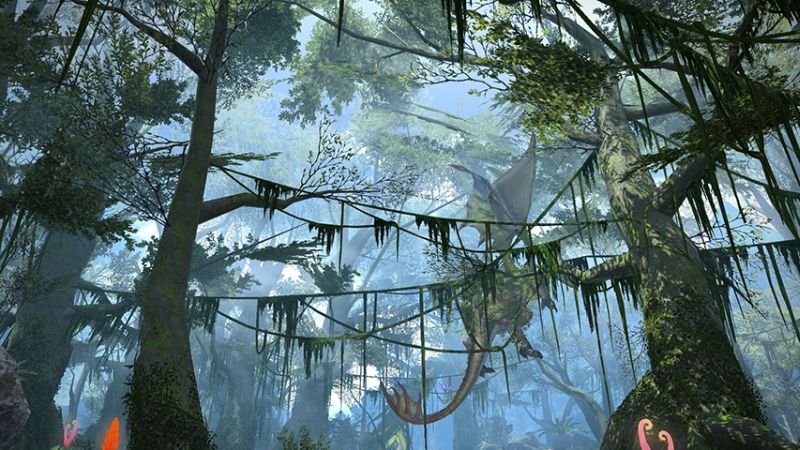
In the Obscure Woods phase, much of the danger comes from forced movement around puddles, tethers, and narrow safe zones. In the Empty Plane phase, players must manage collapsing tiles while also maintaining spacing for line attacks, add control, and stack or spread patterns.
The arena rewards disciplined pathing. Most wipes come from players crossing each other, stepping into occupied tiles, or moving too late after a directional read. The safer approach is usually the smaller one.
Mechanic Archive
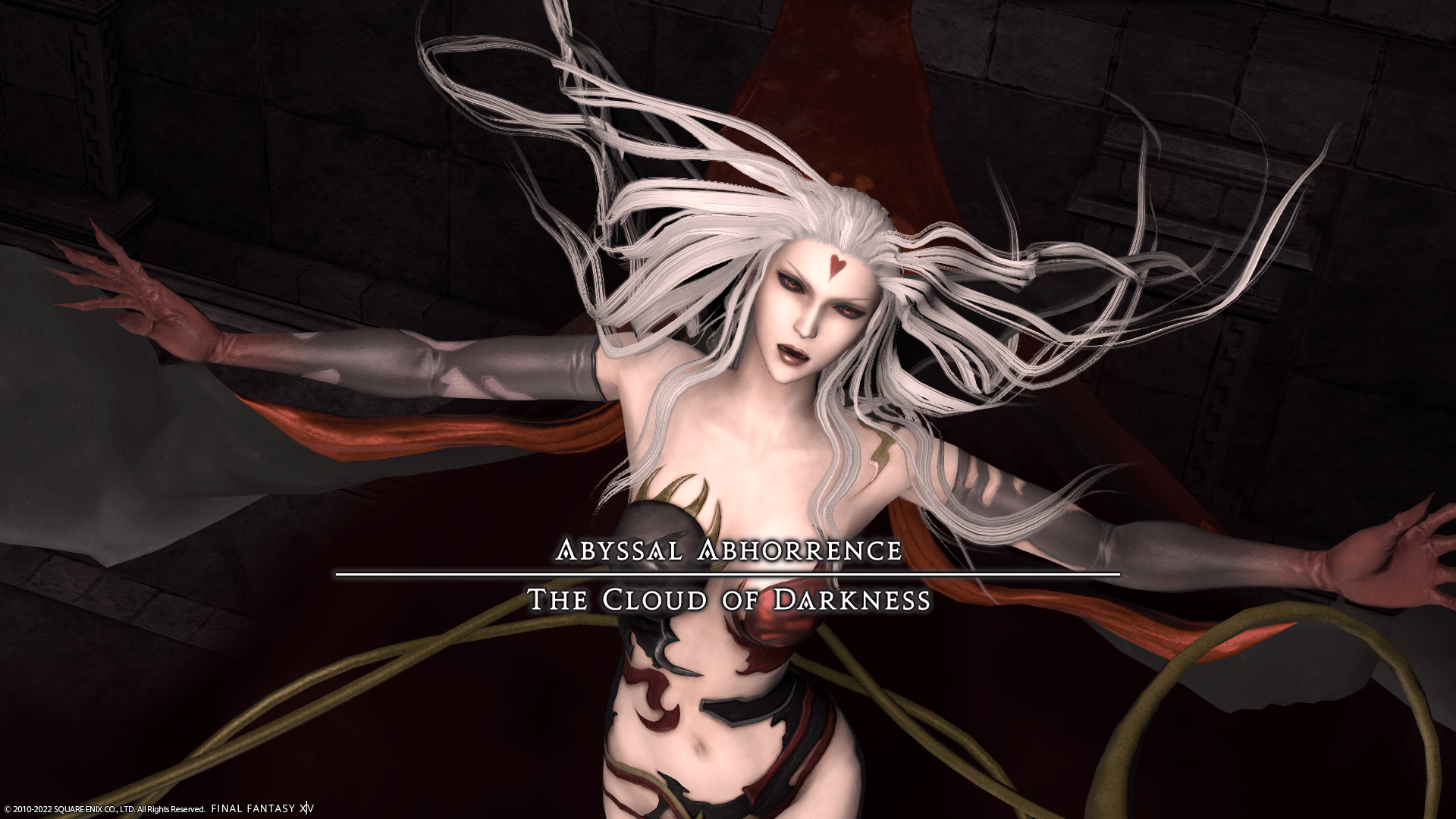
Abyssal Abhorrence: Cloud of Darkness
The encounter is fought against the Cloud of Darkness, who cycles through multiple arena states and repeatedly evolves its core mechanics. The fight asks the raid to learn a small number of patterns very well, then execute them cleanly under tighter restrictions.
Ground-Razing Particle Beam
A raid-wide magical attack that deals unavoidable damage to the full party. This serves as the encounter’s recurring healing check and often bridges major mechanic sequences.
Art of Darkness
The boss uses one of two versions of Art of Darkness, indicated by her animation. One version targets partner stacks, while the other targets all players individually and requires a full spread.
This mechanic is one of the fight’s central assignment checks. Partner pairings should already be fixed before the pull, and spread positions should be equally stable. Players who wait for confirmation instead of reading the boss early tend to run out of space.
Devouring Dark
A heavy hit on the main target that precedes the tankbuster sequence. This sets up the following beam and pressures tanks to handle swaps or invulnerability timing correctly.
Zero-Form Particle Beam
A tank-targeted beam that follows Devouring Dark. The marked tank is fired through in a line, and anyone standing carelessly near that path will be clipped.
The important detail is not just mitigation, but lane discipline. The raid should clear the beam path immediately so the tank resolution stays isolated.
Obscure Woods
A raid-wide transition attack that shifts the encounter into the forest phase. This phase introduces tether management, safe-lane movement, and heavier reliance on split-group structure.
Flood of Obscurity
A room-wide hit with knockback that also places puddles under players. These puddles become dangerous ground effects and should be stacked in controlled locations rather than scattered across the room.
The clean resolution is to use knockback immunity and place puddles at planned intercardinal positions near the boss. Good puddle placement is what creates room for the next mechanic to function.
Rejuvenating Balm
The boss tethers to two roots on opposite sides of the room, causing large side explosions that leave only specific safe lanes. At the same time, players are tethered to seeds and partner tethers, forcing the raid to separate and then cross cleanly to break them.
This is a structure mechanic, not a recovery mechanic. Tanks and healers moving one way while DPS move the other keeps the tether breaks controlled and prevents the phase from turning chaotic.
Anti-Air Phaser Unlimited
A layered attack consisting of a point-blank AoE at the boss, large tank-targeted circle hits, healer stack damage, and a wide boss-facing cone. The sequence resolves in a defined order and asks the raid to stay split into assigned light parties.
Tanks need to drift outward from their group for the tank-targeted hit, then return quickly before the conal follow-up closes the lane.
Wide-Angle Phaser Unlimited
A related phaser sequence, but with a different order and a line-style tank hit instead of the circular version. The attack still pressures light-party structure, but the timing window changes enough that players need to read the cast rather than assuming the previous pattern repeats.
Second Art of Darkness
A faster, more layered version of Art of Darkness. One tentacle glows to indicate the unsafe side, and the attack then resolves into either the partner-stack or full spread pattern.
The clean approach is to solve the side first and then settle into assignments. Trying to handle both at once usually causes overlap or panic movement.
Empty Plane
A heavy raid-wide transition that changes the arena into a tile-based platform and marks sections for destruction. This begins the movement-heavy phase of the fight.
Flood of Emptiness
Marked sections of the platform are destroyed, the center beneath the boss becomes lethal, and players receive debuffs that shape the rest of the phase.
Curse of Darkness
After a delay, players fire line AoEs from the direction they are facing. These must be aimed away from teammates, especially during the tight tile phase where space is limited.
Cloying Condensation
This debuff governs tile collapse behavior. Standing too long on a tile causes it to become unstable, and if two players overlap on the same tile, that tile collapses immediately.
This is the defining rule of the phase. Movement must be coordinated, and even correct mechanic reads can fail if two players route through the same square at the same time.
Hypercharged Condensation
The boss summons Hypercharged Clouds at the cardinals. These move slowly toward the boss and grant her a damage buff if they are not destroyed in time.
Players can apply Heavy to the clouds by standing in front of them, which gives the raid more time to kill them. This phase is much safer when each side already knows who is responsible for slowing and who is responsible for burning.
Full Perimeter Particle Beam
A large donut AoE that leaves a narrow safe ring near the boss’s hitbox. Because the center beneath the boss is unsafe, players need to position carefully on valid nearby tiles rather than simply moving inward blindly.
Deluge of Darkness
A raid-wide AoE that resets the arena to its normal state. This marks the end of the tile phase and the start of the next loop.
Summon
The boss summons two clones in the final standard loop of the encounter. These clones copy Art of Darkness and create overlapping directional pressure with the boss’s own cast.
There is no generous telegraph here. Players need to read where the clones are relative to the boss and identify the remaining safe wedge quickly.
Third Art of Darkness
A compressed sequence of Art of Darkness mechanics in rapid order. The boss first attacks one side, then resolves stack or spread handling, then attacks the opposite side.
This sequence is less about new ideas and more about whether the raid can execute the fight’s core language quickly without losing assignment discipline.
Meteor Towers
During the later Obscure Woods sequence, meteors spawn across the room and each tower must be occupied by a player before impact. Failing to cover them causes heavy raid damage and debuffs.
These towers are layered into the tether break sequence, so players must not tunnel one mechanic and forget the other.
Mini Phase 1 Overlap
The boss revisits the Obscure Woods pattern with knockback puddles, tether breaks, meteors, phaser handling, and a Second Art of Darkness overlap. This is where the encounter begins stacking its earlier lessons together instead of presenting them one by one.
Mini Phase 2 Tile Repeat
The final phase repeats the Empty Plane logic with slightly longer duration and greater strain on movement discipline. If the boss survives through this second tile cycle, the fight approaches enrage quickly.
Encounter Flow
Umbra Savage opens by establishing its two key assignment systems: partner handling and spread locations. Art of Darkness introduces the stack-versus-spread language, while Devouring Dark into Zero-Form Particle Beam establishes the encounter’s tank pressure. After this, the boss transitions into Obscure Woods, where puddle placement and tether discipline begin to matter.
The first forest phase teaches the raid how to preserve structure through Flood of Obscurity, Rejuvenating Balm, phaser handling, and Second Art of Darkness. This is the point where stable light-party movement starts to matter, since later versions of the same phase become much less forgiving.
From there, the fight transitions into Empty Plane, the encounter’s most movement-sensitive section. Tiles collapse if mismanaged, Hypercharged Clouds must be slowed and destroyed, and the raid still has to respect directional attacks and stack or spread resolutions. This phase is won through routing, not speed. Controlled movement across assigned squares is what keeps the platform alive.
After Deluge of Darkness, the boss returns to the normal arena and introduces clone pressure through Summon and Third Art of Darkness. This sequence is the encounter’s first real compression test, asking the raid to read directional danger faster while still respecting the original stack-spread rules.
The final major loop revisits Obscure Woods with extra pressure from Particle Concentration meteor towers, then returns to the tile phase for a longer repeat. By this point, the boss is no longer teaching. The encounter is checking whether the raid can execute the same logic cleanly under fatigue and tighter overlap windows.
In practice, Eden’s Promise: Umbra (Savage) is a positional discipline fight. The mechanics themselves become straightforward once the group locks assignments and movement lanes. Most progression comes from cleaning transitions, reducing unnecessary movement, and making every Art of Darkness resolution look identical pull after pull.
[tavern_related_encounters tier=”edens-promise”]