Eden’s Promise: Litany
Duty Information
Expansion: Shadowbringers
Series: Eden
Tier: Eden’s Promise
Encounter: Eden's Promise: Litany
Players: 8 (Tank / Tank / Healer / Healer / DPS / DPS / DPS / DPS)
Duty Finder Type: Raid (Normal)
Level: 80
Item Level: 485
Unlock Requirement: Shadows of the Past
Encounter Overview
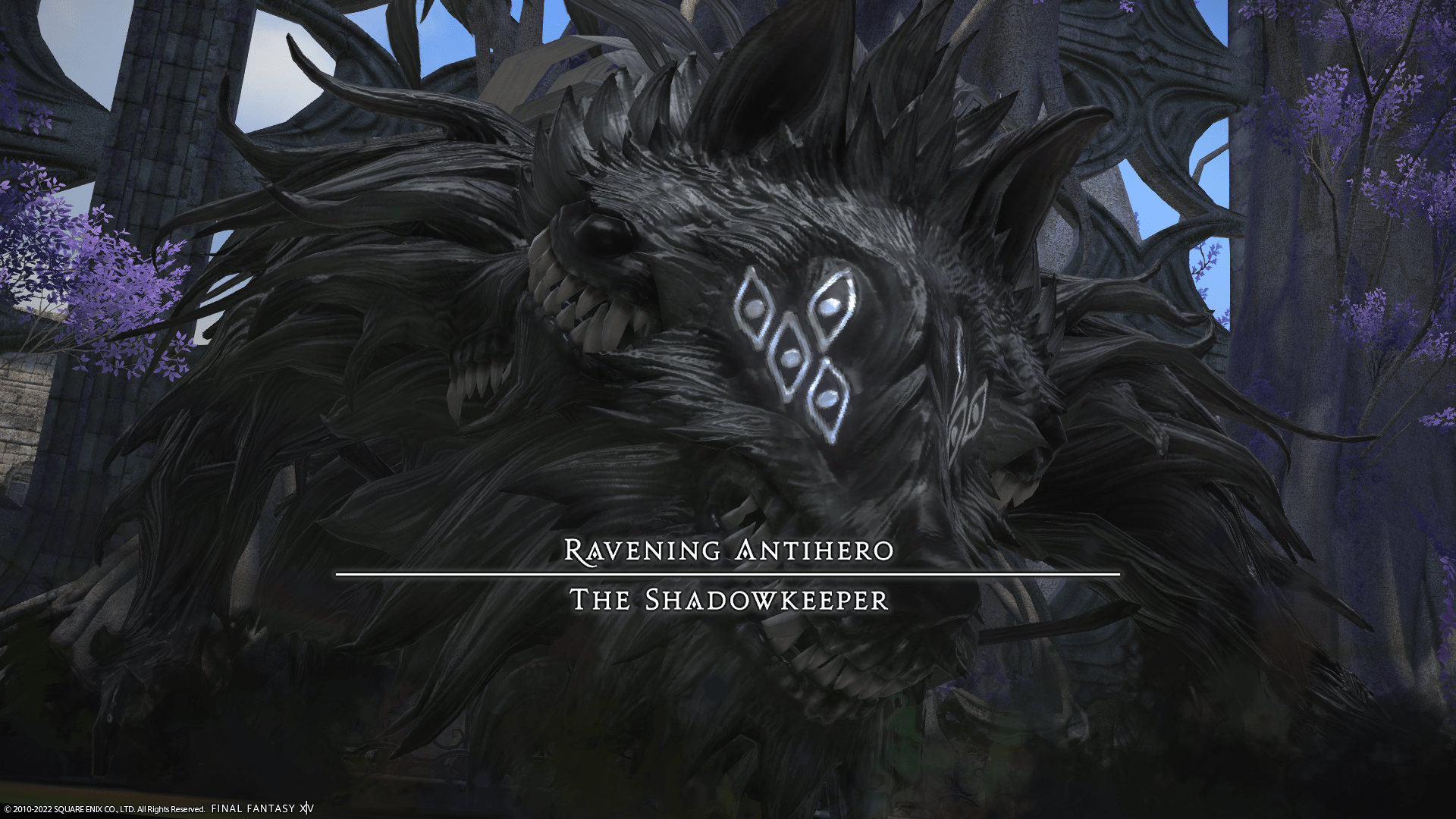
Eden’s Promise: Litany (E10N) is the second encounter of Eden’s Promise and pits the raid against the Shadowkeeper. The fight revolves around directional reads, with the boss repeatedly asking players to identify front versus back and left versus right attacks across two distinct combat forms.
The main wrinkle is that many attacks also appear in shadow variants. These do not always resolve from the boss’s current facing, and instead use a shadow tail indicator to show where the boss will be oriented when the attack goes off. Once that visual language is understood, the encounter becomes far easier to read.
At lower health, the Shadowkeeper starts chaining these directional patterns together more quickly. The encounter still remains readable, but players need to stay alert and avoid assuming each attack resolves in isolation.
Arena Overview
The battle takes place on a square platform with open edges, so knockbacks and poor positioning can send players off the arena. Most mechanics are resolved through directional positioning rather than by moving long distances, which makes it important to stay centered and ready to adjust.
The Shadowkeeper alternates between a beast form and a sword form. The beast phase focuses more on front-and-back reads, shadow clone tracking, and quadrant safety. The sword phase shifts into left-and-right cleaves, tank pressure, and tower coverage.
The arena is generally generous, but several mechanics divide it into unsafe quarters or force players into specific sides relative to the boss. Short, confident movement tends to be safer than running too early or too far.
Mechanic Archive
Ravening Antihero: Shadowkeeper
The encounter is fought against the Shadowkeeper, who alternates between beast and sword stances. Each stance has its own directional attack language, but both rely on the same core skill: reading where the boss will actually strike rather than reacting late to the floor.
Forward Implosion / Backward Implosion
A large arena-wide strike that hits either in front of or behind the boss. The cast name tells you which side is unsafe, so players simply move to the opposite half.
Forward Shadow Implosion / Backward Shadow Implosion
A shadow version of the previous mechanic. Instead of resolving from the boss’s current orientation, the attack uses a shadow tail marker to indicate the direction the boss will be facing when it executes.
The tail is the easiest read. Once players identify where the eventual back side will be, the safe half becomes much easier to find.
Deepshadow Nova
An unavoidable raid-wide AoE that deals moderate damage to the full party. This is the baseline healing check of the encounter and often bridges other mechanics.
Spawn Shadow / Shadow Warrior
The boss summons multiple shadow clones, one of which is marked before the group begins moving around the room. Players need to track where the marked clone ends up, as later positioning depends on that final location.
This is mainly an observation check. Losing track of the marked clone is what makes the mechanic feel messy.
Fade to Shadow
Two shadow pools appear at the edge of the arena and each threatens its quarter of the platform. Safe space remains between the affected quadrants, allowing the group to stay relatively central if positioned correctly.
Shadowy Eruption
A cluster of targeted ground AoEs that forces the party to spread their movement and avoid stepping into overlapping markers.
Beast to Sword Transition
The Shadowkeeper rises up and releases a point-blank attack to mark the transition into sword form. There is little formal cast warning, so players should react to the stance shift itself and move out quickly.
Umbra Smash
A multi-hit tank-targeted sequence that applies slashing vulnerability. In normal mode, the stacks are manageable and usually do not require a forced swap.
Shadow’s Edge
A line tankbuster aimed through the current target. The marked tank should mitigate it, and the rest of the party should avoid standing in line with the boss.
Left Giga Slash / Right Giga Slash
The boss cleaves the named side relative to its current facing. Players move to the opposite side to avoid the hit.
Left Shadow Slash / Right Shadow Slash
A shadow-based version of the side cleave. As with the shadow implosions, the tail indicator shows where the boss will be facing when the attack resolves.
The safe side is determined by the future orientation, not the current one.
Voidgate
Three tower markers appear, each showing how many players are needed to soak them. In this encounter, each tower requires at least two players.
This is a simple coverage check, but the raid still needs to split efficiently so no tower is left short.
Sword to Beast Transition
The boss transitions back with a point-blank knockback that also deals raid-wide damage. Players need to respect the edge of the platform and prepare for healing afterward.
Chained Directional Patterns
After roughly half health, the Shadowkeeper begins chaining directional attacks more rapidly. Players may need to resolve one read while already preparing for the next front-back or left-right pattern.
The core mechanics do not fundamentally change here, but the pace increases enough that late reads become much riskier.
Encounter Flow
The fight opens in beast form and teaches the encounter’s core idea through Forward/Backward Implosion and their shadow variants. These attacks establish that the Shadowkeeper is a read-heavy boss, and that players need to pay attention to both cast names and future facing indicators.
The beast phase also introduces shadow clone tracking, quadrant danger through Fade to Shadow, and simple ground AoE movement. Once those mechanics resolve, the boss transitions into sword form with a close-range burst.
In sword form, the fight shifts from front-and-back reads into left-and-right cleaves. Tank pressure increases through Umbra Smash and Shadow’s Edge, while Voidgate checks whether the raid can still split cleanly while handling directional attacks.
As the fight continues, the Shadowkeeper cycles between these two forms and begins linking mechanics together faster. The challenge is not learning entirely new attacks, but continuing to read the same directional language without hesitation as the pace rises.
In practice, Litany is a positioning fight. Players who stay calm, trust the visual tells, and avoid overmoving will usually find the encounter far easier than its cast names first suggest.
[tavern_related_encounters tier=”edens-promise”]