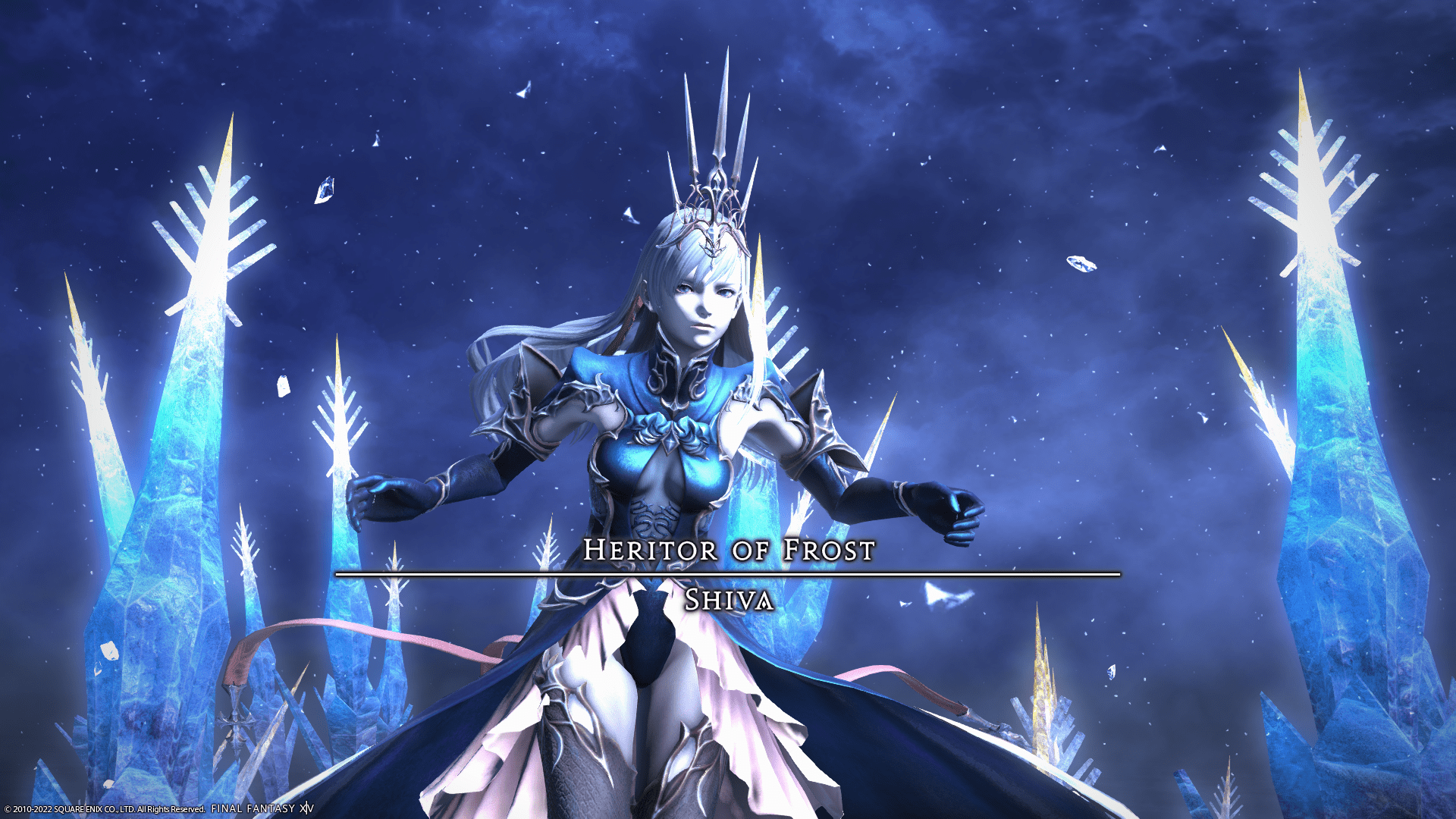
Eden’s Verse: Refulgence (Savage)
Duty Information
Expansion: Shadowbringers Raid Archive
Series: Eden
Tier: Eden’s Verse
Encounter: E8S - Shiva
Players: 8 (Tank / Tank / Healer / Healer / DPS / DPS / DPS / DPS)
Duty Finder Type: Raid (Savage)
Level: 80
Item Level: 480
Unlock Requirement: Talk to Lewrey after completing Life Finds a Way
Encounter Overview
Eden’s Verse: Refulgence (Savage) is the final Savage encounter of Eden’s Verse and the Savage version of E8. Shiva expands the normal-mode identity of the fight into a far more demanding sequence of mirror timing, untelegraphed front-and-back reads, debuff routing, and layered movement checks.
The encounter tests recognition and discipline more than raw speed. Mirror colors dictate when attacks repeat, form changes alter how the arena must be read, and several mini-phases ask the raid to maintain strict assignments while managing towers, chains, knockbacks, or cleanse orders. Many failures come from breaking structure rather than from missing damage.
The platform edge remains lethal throughout the fight. Players can be revived after falling, but edge deaths usually destabilize later mechanics, especially during knockbacks, Thin Ice sequences, and mirror patterns that limit available space.
Arena Overview
The battle takes place on a circular platform with no railing. That lack of protection matters constantly, as several mechanics force either knockback movement or long slides across frozen ground.
Mirror mechanics repeatedly use the outer edge of the arena. These mirrors copy Shiva’s next action, but their timing depends on color: Blue mirrors resolve immediately, Green mirrors resolve shortly after, and Red mirrors resolve last. Once that timing rule is understood, many later mechanics become much easier to read.
The encounter also temporarily transitions into split platforms during the add phase, where each half of the raid must defend a crystal from incoming enemies and tether attacks. Outside of that split, most of the fight is won by clean center control and deliberate movement around the edge only when required.
Mechanic Archive
Absolute Zero
A heavy raid-wide magical attack that appears throughout the encounter. It often acts as a reset point before a new mechanic sequence begins.
Mirror, Mirror
Shiva summons mirrors along the arena edge that repeat her next action. The color of the mirror determines the order of resolution: blue first, green second, red last.
This is the core language of the fight. The raid is almost never solving only Shiva’s cast. It is solving Shiva’s cast plus a replay sequence that travels through the mirror timing order.
Driving Frost
A powerful rear cone that strikes behind Shiva. In Savage, it has no obvious ground telegraph, so players must recognize it by cast knowledge and boss read rather than waiting for floor indicators.
When copied by mirrors, Driving Frost creates cone-based danger zones that usually leave safe space near the mirror itself.
Biting Frost
A massive frontal attack that covers Shiva’s front and flanks. Like Driving Frost, this version is not telegraphed clearly on the floor.
When copied by mirrors, Biting Frost becomes large point-blank danger around each mirror, usually asking the raid to move as far away from the firing mirror as possible.
Diamond Frost
Shiva teleports to center and begins a major overlap sequence built around raid damage, dispels, AoE placements, icicle drops, knockback, and eruption markers.
This mini-phase is less about individual reaction and more about stable placement. Clean marker spacing near the inner ring keeps the resulting star patterns readable and leaves the center available for players who need to wait for knockback timing.
Freezing
A dispellable debuff that causes affected players to freeze solid if left untreated. During early Diamond Frost, one tank and one healer receive it and usually need immediate Esuna support to stay mobile for the follow-up mechanics.
Frigid Stone
AoE markers placed on multiple players that later leave star-shaped line explosions behind. These markers also apply a heavy effect that slows movement after detonation.
The important part is marker placement. Predictable drop spots create predictable star patterns, which makes the knockback resolution far safer.
Frigid Water
Proximity markers that appear during Diamond Frost. These need space and cannot be carelessly overlapped with the rest of the mini-phase.
Players resolving these markers need to consider both knockback direction and the remaining icicle circles that have not yet dropped.
Icicle Drops
Large circular markers appear at the edge of the arena and resolve in sequence as falling icicles. Most of them drop early, but two remain longer than the others.
Those delayed icicles are the hidden danger of the sequence. Safe knockback paths must account for where those last two circles remain active.
Heavenly Strike
A knockback from Shiva’s position that appears during several parts of the encounter. In Diamond Frost, it is used as a forced reposition through the icicle and star-pattern overlap.
Players should think about where they will land, not just where they are standing before the knockback goes off.
Frigid Eruption
Repeated AoE circles under marked players. The affected players need room to keep moving while the rest of the raid preserves safe space.
Double Slap
A strong tankbuster on the primary target that also applies Physical Vulnerability. This usually prompts a tank swap while the cast is resolving.
Redress
Shiva changes forms and alters the rules of the next mechanic sequence. Each form change matters, and the raid should treat the transformation itself as part of the mechanic rather than downtime between casts.
Redress (Holy Form)
Shiva transforms from ice into holy form with a gaze effect. Players who face her during the change are stunned. Unlike easier versions, this does not provide a forgiving visual cue.
Players should be ready to turn away as soon as the transformation begins, then immediately identify which kick follows.
Axe Kick
A massive point-blank AoE around Shiva. In Savage, there is no generous orange telegraph, so the raid must identify it quickly and move out.
Scythe Kick
A large donut AoE that leaves Shiva’s hitbox safe. Like Axe Kick, it is recognized by the cast and animation rather than a floor marker.
Light Rampant
A major mini-phase built around Lightsteeped, chains, towers, moving orbs, and cone attacks. Shiva remains rooted while the raid resolves several layered assignment checks at once.
This is one of the encounter’s most structured mechanics. The phase becomes much more manageable when chained players own tower duties and orb-tethered players focus only on controlled kiting.
Lightsteeped
A stackable debuff gained from certain Light Rampant and later Icelit Dragonsong mechanics. Reaching five stacks causes a detonation that is usually raid-fatal.
This debuff turns every avoidable mistake into a resource problem. Players must track not just survival, but whether they can afford the next required stack from towers or orb contact.
Refulgent Chains
Tethers that bind assigned players together. Moving too close or too far causes the chains to detonate.
The chain check is about maintaining formation while the mechanic progresses. Players should move with intention and avoid sudden pathing changes that stretch or collapse the tether shape.
Meteor Towers
Light Rampant and later Icelit Dragonsong spawn tower sequences that require specific numbers of players to soak them. Early towers require one soaker each, later towers require two, and the final version requires four.
Tower resolution is less about improvising bodies into circles and more about preserving the intended assignment order so Lightsteeped stacks stay controlled.
Bright Orbs
Large light orbs tether to unchained players and chase them. The orbs shrink over time, and colliding with them later is much safer than touching them early.
These are best handled by steady kiting around the edge while staying clear of the chained group and any upcoming cone lines.
Path of Light
Shiva fires cone attacks toward chained players during Light Rampant. These cones overlap the tower and orb responsibilities and punish chained players who drift out of formation.
Banish
Damage dealers are marked for either stacks or spreads depending on Shiva’s visual orb tell. This appears during mirror-and-kick sequences and later returns in Icelit Dragonsong on a tank target.
The main value here is recognizing early whether the marker will remain stack-based or convert into spread handling.
Shattered World
Shiva creates two circles that the raid must enter to divide itself into two four-player groups. Anyone outside a circle when the cast resolves dies immediately.
This is a hard positional gate into the add phase. The split should already be assigned before the cast begins.
Split Platform Add Phase
Each light party is sent to its own platform to defend a central crystal while a Flood of Light gauge threatens to fill. The crystal also deals repeated raid-wide damage during the phase.
Success depends on consistent add control, timely tether interception, and preventing any add from reaching the center.
Flood of Light
A wipe gauge for the add phase. Letting adds hit the crystal or failing certain tether resolutions adds progress to the gauge.
Earthen Aether
An add that attempts to cast Stoneskin shortly after spawning. Interrupting it quickly prevents the add from becoming much harder to kill.
Lightning Aether
An add that reflects damage back at attackers. This pressures healers and discourages careless burst while raid-wide crystal damage is still occurring.
Aqueous Aether
A sturdier water add that can be stunned or slowed. It is less about quick deletion and more about controlled delay while the group burns it down.
Crystalline Snowflake
An untargetable add that tethers to the central crystal. A player must intercept the tether to stop Flood of Light gain, but doing so applies Light Resistance Down.
Because the debuff limits repeat soaks, each platform benefits from a planned intercept order.
Akh Morn
A multi-hit shared attack aimed at the top two players on the enmity list in phase two. Each side of the raid must stack on its assigned tank, and the two groups must remain separate because the resulting debuffs are incompatible.
The mechanic also means both tanks must stay first and second in enmity for the entire final phase.
Hated of Frost / Hated of the Wyrm
Debuffs applied by Akh Morn. Players with one cannot safely overlap the other stack sequence, which is why the raid splits into two stable groups.
Morn Afah
A heavy shared hit on the primary target. This can be shared by the full raid or soloed with tank invulnerability depending on the chosen strategy and what follows next.
Hallowed Wing
Shiva leaps to center and blasts one side of the arena based on which wing is glowing. When mirrors are involved, the raid must solve Shiva’s side blast and the mirror side blast in sequence.
This mechanic becomes much easier once players stop thinking in halves and start thinking in quadrants. The first safe space is created by combining Shiva’s direction with the blue mirror’s direction, then rotating for green and red.
Wyrm’s Lament
A raid-wide hit followed by timed debuffs that must be cleansed through interaction with a rotating Drachen Wanderer and the puddles created by earlier cleanses.
Red debuffs are cleansed by touching the dragon. Blue debuffs are cleansed by touching the puddle left behind by a red cleanse. If a timer expires naturally, the affected player dies.
Drachen Wanderer
A rotating dragon head that circles the arena during Wyrm’s Lament. Red debuff players must intercept it to cleanse, and their contact creates puddles for blue debuff players.
The mechanic is really a cleanse order puzzle. Short timers go first, and the raid must respect the movement of the dragon and any overlapping Hallowed Wing casts.
Joyless Dragonsong
A wipe condition if Wyrm’s Lament is mishandled and players die before the sequence properly resolves.
Redress (Ice Form)
Shiva covers the arena in Thin Ice, causing players to slide almost the full diameter of the platform when they move. Thin Ice resolves midway through the following cast, leaving only a short reaction window afterward.
Twin Stillness
A sequence of Biting Frost followed by Driving Frost after Thin Ice. Players need to move behind Shiva first, then reposition quickly for the follow-up.
Twin Silence
The inverse of Twin Stillness, using Driving Frost first and Biting Frost second. Players move in front first, then behind.
Redress (Hraesvelgr)
Shiva assumes her wyrm form and immediately places Akh Rhai at player positions once the transformation completes.
The raid commonly stacks to bait the initial drops together, then moves cleanly away once the transformation is visible. This keeps the arena organized for whatever follows.
Akh Rhai
Multi-hit AoEs that appear at player positions after Hraesvelgr transformation. Poor bait spacing quickly clutters the platform and can overlap later stack handling.
Holy
A proximity mechanic that may remain as a central blast or split into multiple edge blasts depending on Shiva’s orb tell. This appears during the gaze-and-mirror sequence in the latter half of the fight.
Embittered Dance
A Scythe Kick followed by an Axe Kick. Players first move into safety for the donut, then transition outward for the point-blank hit.
Spiteful Dance
The reverse of Embittered Dance. Players start far away for Axe Kick, then move inward for Scythe Kick.
Icelit Dragonsong
A late-fight mini-phase that combines Lightsteeped management, chains, towers, freezing debuffs, Frigid Stone, knockback, Banish, and a final conal blast sequence called The House of Light.
This is one of the most assignment-heavy parts of the fight. The phase is not won by freestyle adjustments. It is won by each role handling its designated job cleanly so that no one reaches five Lightsteeped stacks before the finish.
Bright Hunger Towers
Tower waves used during Icelit Dragonsong. These again require specific soak counts and must be handled while preserving Lightsteeped thresholds across the whole raid.
Draconic Strike
A knockback from Shiva during Icelit Dragonsong that is used to reposition players through the star-pattern layout.
The House of Light
A final blast sequence that fires cone attacks at every player simultaneously. The raid must already be spread cleanly enough that each cone is isolated to a single target.
Wyrmclaw / Wyrmfang
Paired debuffs used in the second Wyrm’s Lament sequence. Two Drachen Wanderers appear this time, allowing simultaneous cleanses, but the cleanse order still matters because Akh Morn and Morn Afah continue to pressure the raid during the sequence.
Mirror, Mirror Enrage
Near the end of the encounter, red mirrors fill the arena and prepare to replay Hallowed Wing around the platform. If Shiva is not defeated before these final mirror casts resolve, the raid is wiped.
Encounter Flow
The fight opens by teaching the Savage mirror language immediately. Absolute Zero is followed by Mirror, Mirror, and the raid is asked to identify whether Shiva uses Driving Frost or Biting Frost while also understanding the green-red mirror timing that follows. That opening pattern establishes the read-and-rotate style used throughout the encounter.
The first major overlap is Diamond Frost, where dispels, Frigid Stone placement, proximity markers, icicle drops, knockback, and Frigid Eruption all happen in close succession. This sequence checks whether the raid can preserve clean inner-ring structure and think ahead about knockback landing zones instead of reacting late.
After a tank swap on Double Slap, Shiva shifts into Holy form. The raid must respect the transformation gaze and then identify either Axe Kick or Scythe Kick without the generous telegraphs present in easier difficulties. That form-read emphasis carries into Light Rampant, the encounter’s first major assignment wall.
Light Rampant combines Lightsteeped management, chains, tower soaks, shrinking orbs, and Path of Light cones. The mechanic punishes sloppy role drift and rewards stable ownership. Once that resolves, Shiva returns to mirror play with holy kicks and Banish, asking the raid to layer marker handling onto the same mirror timing logic.
The encounter then transitions through Shattered World into a split-platform add phase. Each light party must defend its crystal through four waves while interrupting, stalling, soaking, and intercepting correctly. This phase is less about boss mechanics and more about clean group discipline under constant raid-wide pressure.
Phase two begins with Shiva’s Hraesvelgr fusion form. From here, both tanks must control enmity at all times because Shiva auto-attacks the top two targets continuously. The raid splits for repeated Akh Morn hits, handles Morn Afah, then begins a long series of mirror-enhanced Hallowed Wing patterns, debuff cleanses through Wyrm’s Lament, and form changes into ice and wyrm states.
Midway through the final phase, the fight cycles through some of its hardest sequencing: Thin Ice into Twin Stillness or Twin Silence, Hraesvelgr transformations with Akh Rhai, multi-stage gaze resolution through large mirror arrays, Holy positioning, and kick combinations through Embittered Dance or Spiteful Dance. At this point, the encounter expects full comfort with the mirror color language and with form-specific movement.
The late-fight climax is Icelit Dragonsong, which recombines many earlier ideas into one dense execution test. Players manage Lightsteeped thresholds, chained positioning, Frigid Stone placement, knockback routing, tower order, Banish handling, and final cone spreads before transitioning into one last Thin Ice sequence and a second, more demanding Wyrm’s Lament.
The encounter ends with a final mirror sequence that sets up a hard enrage through repeated Hallowed Wing reflections. In practical terms, Refulgence Savage is a raid of pattern literacy. Once the group fully understands mirror timing, debuff ownership, and movement order, the fight becomes far more stable than its raw visual complexity suggests.
Related Encounters
| Order | Boss | Normal Guide | Savage Guide |
|---|---|---|---|
| 1 | Ramuh | E5N Guide | E5S Guide |
| 2 | Ifrit & Garuda | E6N Guide | E6S Guide |
| 3 | Iconoclasm | E7N Guide | E7S Guide |
| 4 | Shiva | E8N Guide | E8S Guide |